 ← kygit.com
Source code, US hosts, and the encrypted-transfer pattern
A draft position paper for European teams. Worst case first, mechanism second, no adjectives.
This paper was written by the people who build KyGit. It is not legal advice, and it has not yet been reviewed by counsel. Every legal statement below carries its date and its source, because several of them are moving. Read it as a map to hand to your own lawyer, not as a substitute for one. Corrections and disagreements are welcome at info@kychee.com.
Kychee is a US company. KyGit's storage is Amazon S3, in the United States. If you came here looking for a European host, we are not one, and we would rather say so in the first paragraph than in the fine print. What we are is a code-hosting arrangement in which the US host cannot read what it holds — and that property is the one European transfer guidance singles out as sufficient on its own.

The short version
- No law forbids a European company from keeping private source code with a US provider. There is no deadline, and nobody is out of compliance today for using GitHub.
- The GDPR reaches personal data, and most source code is not personal data. Commit author identities, test fixtures, datasets, notebooks, and logs can be.
- Transfers of that personal data currently rest on the EU–US Data Privacy Framework. It was upheld at first instance in September 2025; the appeal is pending with no hearing date. If it falls, transfers fall back to standard contractual clauses plus supplementary measures.
- The European Data Protection Board names one hosting pattern as effective on its own: data encrypted before it leaves you, under keys the host never holds. That is what KyGit is. Encryption at rest at a host that holds the keys is not that pattern.
- This helps only where KyGit is where the code lives. An encrypted copy beside a readable origin changes your durability posture, not your confidentiality posture.
What the law requires today (September 2026)
The honest map first, because a product page that starts with the product is a product page that is hiding something. None of what follows is a reason to buy anything. It is what we found when we asked whether European teams are required to move, and the answer is that they are not.
The GDPR, and what in a repository it reaches
The GDPR applies to personal data. A repository of source code is mostly not personal data. What can be: commit author names and email addresses (your employees' and contributors' data, on every commit, forever), test fixtures and seed data copied from production, datasets and notebooks, log files checked in by mistake. If your repositories are clean of all of that, the transfer rules may not touch them at all, and the rest of this paper matters for trade secrets and contracts rather than data protection. If they are not clean, the transfer rules apply to the whole repository, because you cannot transfer half a git object.
The transfer mechanism, and how stable it is
Transfers of personal data to the United States currently rest on the European Commission's July 2023 adequacy decision for the EU–US Data Privacy Framework. The first direct challenge, Latombe v Commission (T-553/23), was dismissed by the General Court on 3 September 2025. That judgment was appealed to the Court of Justice on 31 October 2025 (C-703/25 P); as of this writing no hearing date has been announced, and commentators do not expect a ruling before late 2026 or 2027. Separately, on 29 June 2026 the US Supreme Court held in Trump v. Slaughter that the President may remove Federal Trade Commission commissioners without cause; privacy advocates argue this weakens the independent-oversight structure the adequacy decision cites.
We do not predict the outcome. We note two facts. The Court of Justice struck down both previous frameworks, Safe Harbor in 2015 and Privacy Shield in 2020. And the fallback is already written: standard contractual clauses plus supplementary measures, per the EDPB's Recommendations 01/2020. That document is the subject of the next section.
The “no AI training” clause
Since 2025 a clause forbidding the vendor from training models on customer data has become standard in enterprise contracts. It is worth being precise about what it reaches. It covers customer data, which lives in your database, not in your repository. It does not reach your own source code unless the code is itself the deliverable (agencies and contractors), the repository contains customer data (see above), or your customer simply asks. Where it reaches a platform that stores its users' code, it bites directly, because the platform is the AI company. We say this plainly because we would rather you not buy KyGit for a reason that does not apply to you.
GitHub's own terms, as published
Dated facts, not accusations. GitHub states that private repository content at rest is not used to train its models. From 24 April 2026, interaction data from Copilot Free, Pro, and Pro+ — prompts, suggestions, and surrounding context, including while working in private repositories — is used for training unless the user opts out; Copilot Business and Enterprise are excluded. An organisation on Business or Enterprise seats is contractually covered today. The point is structural rather than about any one host: a policy is something a host can change, and this one changed once this year. A key the host never received is not a policy.
The rest of the alphabet
- AI Act (Regulation (EU) 2024/1689). Obligations fall on providers of AI systems and models, including transparency about training data for general-purpose models. It places no duty on you to prevent training on your code.
- Trade Secrets Directive (Directive (EU) 2016/943). Protection depends on taking “reasonable steps” to keep the secret secret. Hosting under a confidentiality contract is generally treated as reasonable. Hosting under terms that permit the host to read and reuse the code is a question for your lawyer; we are not aware of a ruling either way.
- NIS2 (Directive (EU) 2022/2555) and DORA (Regulation (EU) 2022/2554, applying since 17 January 2025). Supply-chain and ICT third-party risk: registers of providers, contractual terms naming where data is processed and stored, exit strategies, and source-code access for critical functions. Neither bans a US host. Both make “where is our code and who can read it” a question you must be able to answer in writing.
- Sovereignty schemes such as France's SecNumCloud test the provider's legal structure, not its cryptography. Kychee is a US company and does not qualify. If your requirement is entity-based, KyGit does not meet it, whatever the mathematics says.

The EDPB pattern: use case 1
The EDPB's Recommendations 01/2020 on measures that supplement transfer tools (final version adopted 18 June 2021) describe, in Annex 2, a handful of situations in which a technical measure makes a transfer acceptable even where the destination country's law would otherwise be a problem. The first is titled “Data storage for backup and other purposes that do not require access to data in the clear.” Paraphrased below; read the original before you rely on any of it.
The exporter uses a hosting provider in a third country to store data, and the provider does not need to see the data in the clear. The EDPB considers the encryption an effective measure when, in short:
- the data is encrypted with strong encryption before transmission;
- the algorithm and its parameters are state of the art and robust against cryptanalysis by the public authorities of the destination country, taking their resources into account;
- the strength and key length reflect how long confidentiality must be preserved;
- the algorithm is flawlessly implemented by properly maintained software whose conformity to the specification has been verified, for example by certification;
- the keys are reliably managed — generated, administered, stored, tied to the intended recipients where relevant, and revoked — by the exporter, or by an entity the exporter trusts, in the EEA or an adequate country;
- the keys are retained solely under the control of the exporter or that trusted entity.
The reasoning is short. When all six hold, the importer holds ciphertext and no way to open it, so there is nothing for its authorities to compel from the importer. The transfer is of bytes, not of readable data.

How KyGit maps onto it
Condition by condition, with the place to verify each one without taking our word for it. The fourth row is the one we meet least well today, and it says so.
| Condition | KyGit | Where to check |
|---|---|---|
| 1. Encrypted before transmission | Encryption happens on your machine, inside a plain git push, before a byte leaves it. Your repository ciphertext moves directly between your machine and storage — our servers never handle it. |
What happens on push; the protocol specification. |
| 2. State-of-the-art algorithm | Published standards only, in mainstream open-source implementations: Ed25519, HPKE (RFC 9180), XChaCha20-Poly1305, HKDF-SHA-256, SHA-256/HMAC. What is ours is the protocol that composes them. | The suite and the security FAQ. |
| 3. Key strength vs. confidentiality period | 256-bit symmetric keys, one HKDF-derived key per object, forward-only epoch rotation when a recipient is removed. No date after which the ciphertext is expected to weaken within the horizon a trade secret needs. | Keys, envelopes, and what losing them means. |
| 4. Verified implementation | Not independently reviewed yet. What exists today: two independently built open-source implementations (a TypeScript client and a Rust verifier that shares no code with it), a frozen test-vector set both must pass, and a recorded adversarial review. An independent cryptographic review is the next gate, and until it is done the vocabulary on this page is the ceiling on what we will claim. | Two implementations, the vectors, the review. |
| 5. Keys managed by the exporter | Keys are generated on your machine and live in your keystore. Teammates receive sealed envelopes; a removed teammate is cut off by epoch rotation. Run402 holds zero vault keys, so there is no key-management duty on our side to audit. | Keys and envelopes; removing a teammate. |
| 6. Keys solely under the exporter's control | Run402 cannot decrypt your vault or repository history. The confidentiality claim is scoped to the vault: source payload and repository-history content are ciphertext-only; the substrate retains only enumerated plaintext metadata and holds zero vault keys. | Who sees what; the threat model. |
What the importer can see, stated in full
This is not zero-knowledge hosting, and an assessment that says otherwise will not survive review. The control plane sees that a vault exists and whose it is, principal identities and access times, object counts, ciphertext sizes and ids, generations and cadence. That list is closed and enumerated in the threat model; anything beyond it is a protocol violation. It is also exactly what a subpoena or government order served on us would yield — the legal-process answer states the worst case first and does not claim the metadata is harmless.
Policy versus incapacity
An assessment that relies on a host's policy has to be redone every time the policy, or the host's owner, changes. An assessment that relies on the host's incapacity does not. We hold no key to change our minds with, and that holds against a future us too, including a future us, after an acquisition. That is the sentence we would put in front of a regulator, and it is the reason this page exists.
The copy in your own bucket
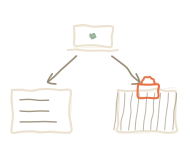
Your ciphertext replicates to a bucket you own. We can't decrypt your repository history — and we can't hold it either. If that bucket is in Frankfurt or Dublin, the ciphertext copy stays in the EU, and the exit strategy DORA asks you to write is one paragraph long: if we disappeared tomorrow, your repository is recoverable from a bucket listing and your keys, with an open-source tool. No server required. Provable, not promised.
Where this does not help
Read this section twice. It is the one your assessor will read first.
- Origin, not mirror. If your readable origin stays at a US host and KyGit sits beside it, the host can still read everything, and this paper's argument does not apply to you. What you gain is a second copy in an independent failure domain, which is a durability improvement, not a confidentiality one. For the confidentiality claim, KyGit has to be where the code lives.
- No review surface. KyGit is a remote. It has no pull requests, no issues, no CI runners. Where humans review each other's code in a browser, they will keep doing that at a host that can read it. Where KyGit fits as the origin today: repositories written and pushed by agents, code held in custody for a client, and platforms that store their users' code behind their own interface.
- The deploy lane. A run402 project that also deploys hands the deploy lane plaintext artifacts of each release, by design. The vault-only confidentiality sentence above is scoped for that reason. A repository that is vaulted and never deployed through run402 stays inside the scope.
- Metadata is real. Who, when, how big, how often. A compelled host produces it. Traffic-analysis countermeasures are not part of the current protocol.
- A US company, with US storage. The primary bucket is in the United States. There is no EU entity and no EU-only hosting option. Entity-based sovereignty requirements are not met.
- Not independently reviewed yet. Condition 4 above. If your assessment requires a certification or a third-party review report, we do not have one to hand you today.
- Keys can be lost. The vault protects source history from host-side loss while a principal keystore survives. Lose every keystore and every envelope, and no one, including us, can recover the content. Read what losing keys means before you rely on any of this.
For your transfer impact assessment or vendor file
What to cite, in the order an assessor will ask for it:
- The observer table in the threat model — the enumerated answer to “what can the importer access.”
- The protocol specification and the independent Rust verifier — the answer to “how do we check without trusting the vendor.”
- The legal-process answer — the worst case, in the vendor's own words.
- This page, for the mapping to Recommendations 01/2020, with its date.
On request we will provide, in writing, a data processing agreement, the sub-processor list (Amazon Web Services), and the same worst-case statement above signed by the company. Ask at info@kychee.com.
Sentences you may quote verbatim from this site: “Run402 cannot decrypt your vault or repository history.” “Your ciphertext replicates to a bucket you own.” “We hold no key to change our minds with.” Please do not paraphrase them into something stronger; the exact wording is what we can stand behind.

Talk to us
We are talking to European teams now, before we build anything more around this, to learn whether the question above is one you actually get asked. If you are a data-protection officer, a security lead, or an engineering lead at a European company and can spare twenty minutes, we would like to hear where source-code custody sits on your list — including “nowhere.” That answer is as useful to us as the other one.
info@kychee.com, subject “KyGit in Europe.” We are in Amsterdam; a coffee works too.
Try it
Let your own agent walk the mapping on a real repository before anyone writes a memo.
Do this: paste this into your coding agent’s chat.
Read https://kygit.com/europe and https://kygit.com/llms.txt. Can KyGit be the origin for our private repos so that no US host holds readable source? Set it up for this repo.
Get started with kygit.com: read https://kygit.com/llms.txt and add KyGit to this repo as an encrypted second remote.
Sources
- EDPB, Recommendations 01/2020 on measures that supplement transfer tools, version 2.0, adopted 18 June 2021. Annex 2, use case 1.
- General Court, Latombe v Commission, T-553/23, judgment of 3 September 2025. Summary: IAPP.
- Appeal C-703/25 P, lodged 31 October 2025. Analysis: Berkeley Technology Law Journal, February 2026.
- Trump v. Slaughter, US Supreme Court, 29 June 2026, and its bearing on the adequacy decision: commentary (secondary; verify against the opinion).
- GitHub Copilot training-data policy change effective 24 April 2026: GitHub community discussion; Help Net Security, 26 March 2026.
- Standard “prohibit AI training” clause language: Common Paper.
- Regulation (EU) 2024/1689 (AI Act); Directive (EU) 2016/943 (trade secrets); Directive (EU) 2022/2555 (NIS2); Regulation (EU) 2022/2554 (DORA).
- KyGit's own claims ceiling: the threat model and how it works.

Made with ❤️ in Amsterdam